Obby: Rocket Shopping Cart — A Practical Track-Reading Guide
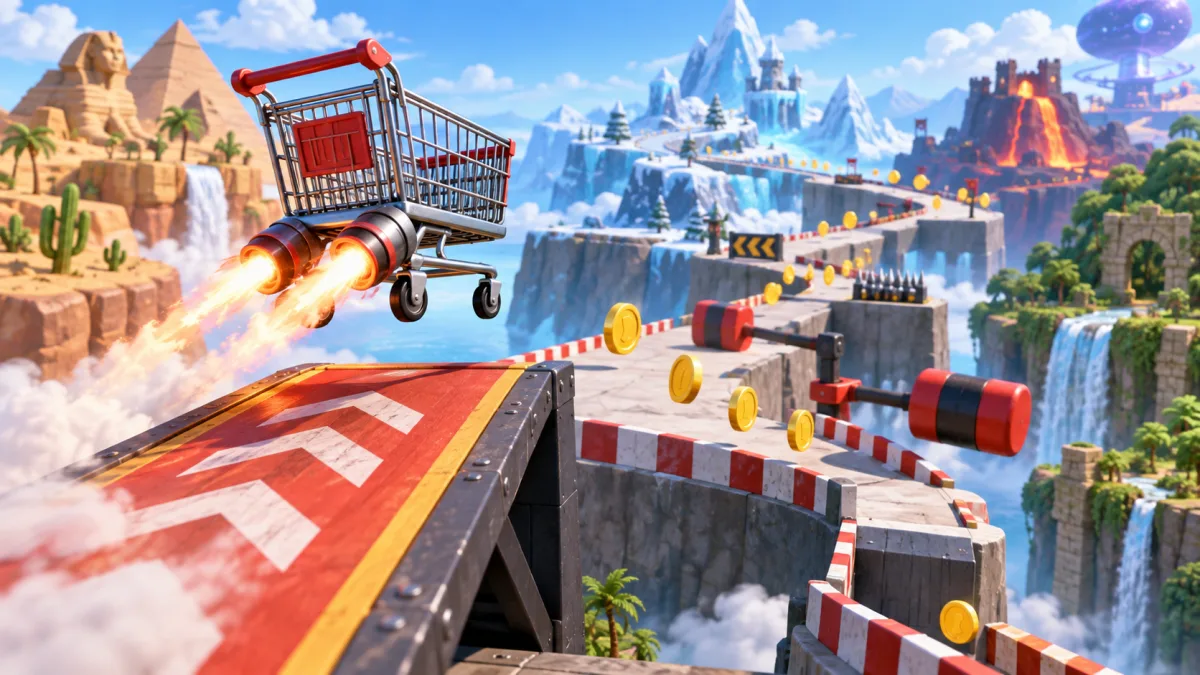
Obby: Rocket Shopping Cart is represented by an original wide illustration of a metal cart launching from a marked ramp toward a long obstacle route. The confirmed description mentions colorful tracks, barriers, coins, boosts, themed worlds, vehicles, styles, pets, and distance. This guide stays with those supplied ideas and does not invent controls, exact statistics, hidden systems, or a particular course layout.
First Reading: Trace the Route Before the Cart
Begin at the large red ramp in the foreground, then follow the pale track as it crosses gaps and turns into the distance. The route passes several clear obstacle types: low barriers, rotating forms, narrow edges, and rows of coins. Reading that sequence first makes the airborne cart feel connected to a destination rather than suspended without context.
Separate Launch Space From Landing Space
The departure ramp uses strong color and a broad surface. The next platform is narrower and surrounded by open air. This difference creates a visible question about distance without claiming the exact result of the jump. Clouds, waterfalls, and cliffs keep the gap readable at a glance.
Open Obby: Rocket Shopping Cart for the game page or browse more entries in Arcade Games.
Use Repetition to Anticipate Obstacles
Red-and-white rails repeat along the route, linking separated platforms into one system. Coins form another repeated line, while black-and-red moving shapes break that order. The safest visual reading is to notice where repetition stops: an interrupted rail, a missing stretch of floor, or an object crossing the central path.
Practical Track Checklist
- Locate the next solid platform before focusing on decoration.
- Compare the width of the cart with the available track.
- Use rails and coin lines to identify the dominant direction.
- Notice moving or crossing shapes that interrupt the route.
- Treat themed scenery as context, not proof of an exact level.
Why the Themed Distance Stays Useful
Desert ruins, snowy peaks, volcanic structures, and green stone passages appear far apart in the illustration. They echo the supplied idea of themed worlds but remain intentionally generic. Because they are placed in the distance, they add variety without competing with the immediate launch and landing geometry.
The practical conclusion is simple: route, gap, and interruption are the three most useful visual layers. The UnblockedGamesT homepage provides a path to other browser titles when you want to continue browsing.
Read Speed Through Spacing
Objects placed close together make the route feel busier, while longer empty sections create visual breathing room. The illustration alternates those intervals: clustered coins near a turn, a quiet approach to a gap, then several obstacles across the next platform. This spacing suggests changes in pace without assigning exact speed values or claiming a specific sequence from the game.
The rocket flames add direction but do not overwhelm the cart silhouette. Their brightest area stays behind the vehicle, leaving its wheels, basket, and front edge readable. That clarity matters because the unusual vehicle is the article’s main subject; scenery and effects should explain its movement rather than hide it.
Across the full frame, the unusual cart remains the constant reference. That continuity helps connect launch, flight, and the distant route without turning the artwork into an exact map.